A Timeline of Jet Instability Research
A chronological and topological review of past and recent progress in the analysis of jet instability
Editor
Lutz Lesshafft
Linear impulse response in hot round jets (2007)
Lutz Lesshafft, Patrick Huerre
DOI: 10.1063/1.2437238
Two main questions are treated in this article:
- What physical mechanism causes absolute instability in low-density jets?
- How are shear-layer and jet-column instability modes properly characterised and distinguished?
The analysis is local, and entirely based on spatio-temporal modes, i.e. modes that have complex frequencies as well as complex wavenumbers. We consider those spatio-temporal modes that appear in the linear impulse response, i.e. the linear wavepacket that evolves out of a singular perturbation impulse in a parallel flow. According to Huerre (2000), these are the modes that travel at a real group velocity, and which can therefore be identified as the absolute modes in a co-moving frame of reference. Consequently, we recover the same family of instability modes as Jendoubi & Strykowski (1994).
The answers to the two questions above are as follows:
- Absolute instability is caused by a destabilising effect of the baroclinic torque, which in the case of a light jet acts in phase with the standard shear instability. (In a heavy jet, the baroclinic effect is out of phase with the shear instability and therefore is stabilising, not shown in the paper).
- Shear-layer and jet-column modes are cleanly distinguished in the context of the linear impulse response wavepacket, as long as the shear layer thickness and the jet radius are well separated. Shear-layer modes achieve significantly higher growth rates, but only at group velocities around half the jet velocity; they are therefore convected away from the source and are not responsible for absolute instability. Jet-column modes dominate the impulse response wavepacket at low group velocities, including vg=0. The absolute mode is always of the jet-column type.
In my understanding, the distinction between shear-layer and jet-column modes cannot be made in the context of temporal or spatial analysis. Some confusion exists in the literature on this point, because these terms are often used in a vague sense. In the context of global analysis, where the separation between jet radius and shear layer thickness necessarily disappears downstream, this distinction is largely irrelevant anyway...
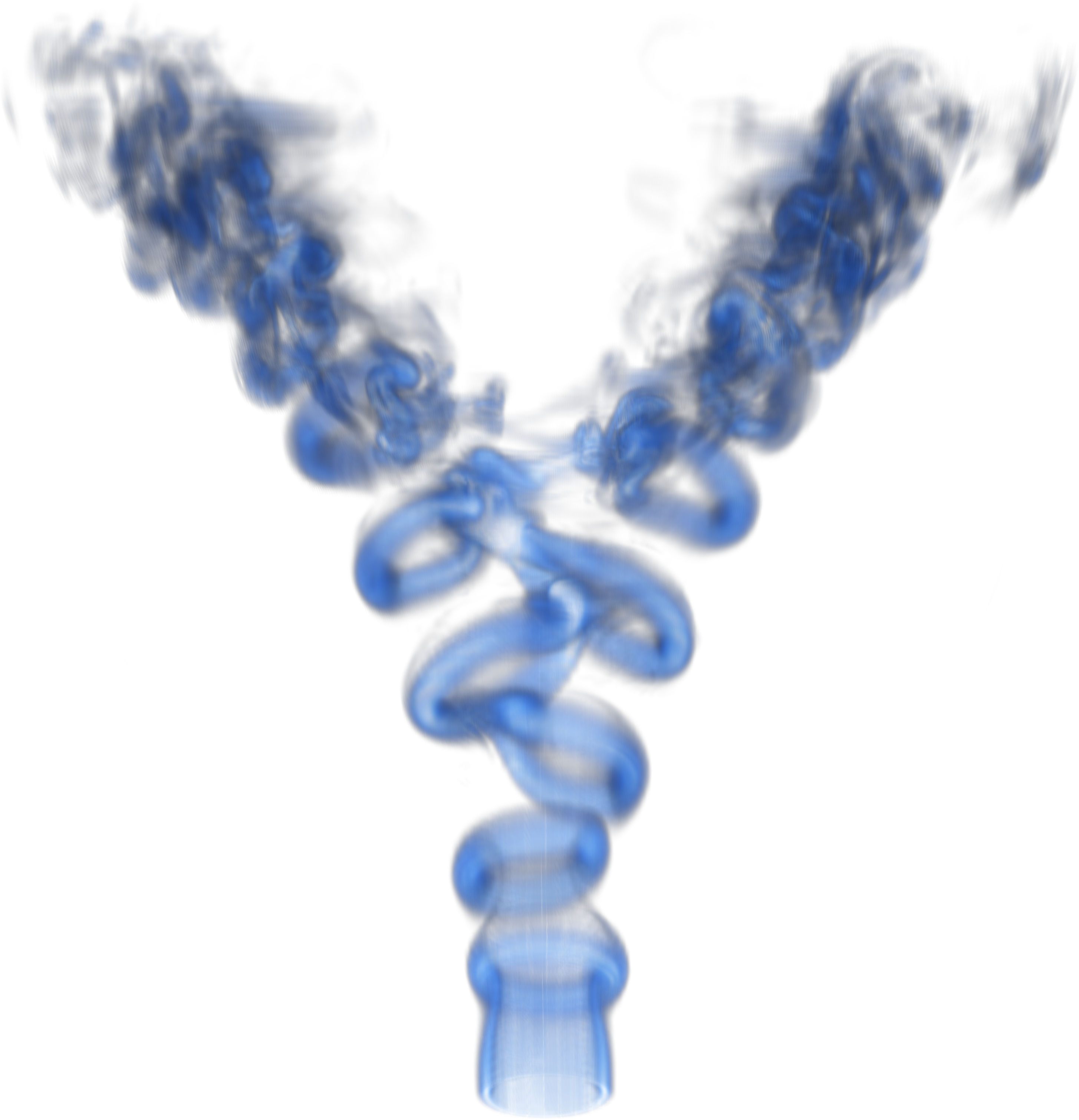
The baroclinic torque mechanism re-appears in a similar study on axisymmetric wakes by Meliga et al. (JFM 2008), and in the later global instability studies by Bharadwaj & Das (JFM 2017) and by Chakravarthy et al. (JFM 2018) on light jets and plumes.
Note that there is a sign error in equation (16) of this paper. This is a typo, the signs in the instability code were correct.
Subjects
A peeriodical is a lightweight virtual journal with you as the Editor-in-chief, giving you complete freedom in setting editorial policy to select the most interesting and useful manuscripts for your readers. The manuscripts you will evaluate and select are existing publications—preprints and papers. Thus, a peeriodical replicates all the functions of a traditional journal, including discovery, selection and certification, except publication itself.
Why set up a peeriodical? The traditional journal has changed remarkably little in centuries and many people feel that scientific publishing is stuck in a rut, subject to a corporatist drift, and is not serving science optimally. The advent of preprints in many fields beyond those served by the ArXiv is liberating the dissemination of research, but most other journal functions have not been replaced effectively. Now you—all researchers—have the opportunity to select and certify research according to your own criteria. We expect peeriodical subject matters and editorial policies to be extremely varied. Some peeriodicals may wish to target narrow domains, while others will adopt a generalist approach. Some peeriodicals will be inclusive, focusing on discovery, whereas others may aim to enforce stringent quality criteria, prioritising certification. The point is that all approaches are permitted and supported—we hope you will innovate! You can create multiple peeriodicals. It will be users and readers who decide which peeriodicals they find useful and interesting. Users can sign up to receive alerts from any peeriodical they wish.
A peeriodical has one or more editors. Anybody can set-up a peeriodical and either operate it alone or invite colleagues to form an editorial board or community. The editors can select "manuscripts"—existing papers or preprints—to consider, either spontaneously or through suggestions from other researchers, including of course the authors. Note that there is no obligation that the manuscript be recent; for instance, we expect that some peeriodicals could focus on underappreciated classics. After all, predictions about scientific impact are generally more accurate for the past than the future. If the editors wish, they can solicit reviews for the manuscript via the Peeriodicals interface. Reviews will be published and the referees will have the option of posting anonymously or signing their review. Editors may decide at any time to accept, reject or comment on the manuscript, taking into account the comments received. They may of course suggest improvements to the manuscript or underlying study. If they justify their decision, their editorial decision will also be published.
How will Peeriodicals fit into the publishing landscape? We see them as a space without entry barriers in which researchers can innovate and explore new approaches to scientific dissemination, in parallel to the traditional publishing industry. There are related and complementary initiatives, notably the overlay journals promoted by Tim Gowers, exemplified by Discrete Analysis, but also Science Open Collections, PLoS Channels, the APPRAISE initiative and Peer Community in... Each of these projects has their own specificities and goals. Nobody yet knows exactly what the future will look like, but we strongly believe that we are about to experience a period of rapid evolution in the dissemination of science and we hope that Peeriodicals will inspire and help you to share your imagination and expertise with the whole research community.
For those starting a peeriodical, you will discover that the hardest part is building up an audience. Unfortunately, we can't yet guarantee you the exposure you would get from a paper in a glamour journal. Reviews with scientific content will be mirrored on PubPeer, offering an audience through the PubPeer browser and Zotero extensions. However, it will be largely up to you to run your publicity, most likely through social media. We are on Twitter (@PEERIODICALS) and will of course help out as we can.
Get started now by requesting an invitation with the link in the top right menu.